

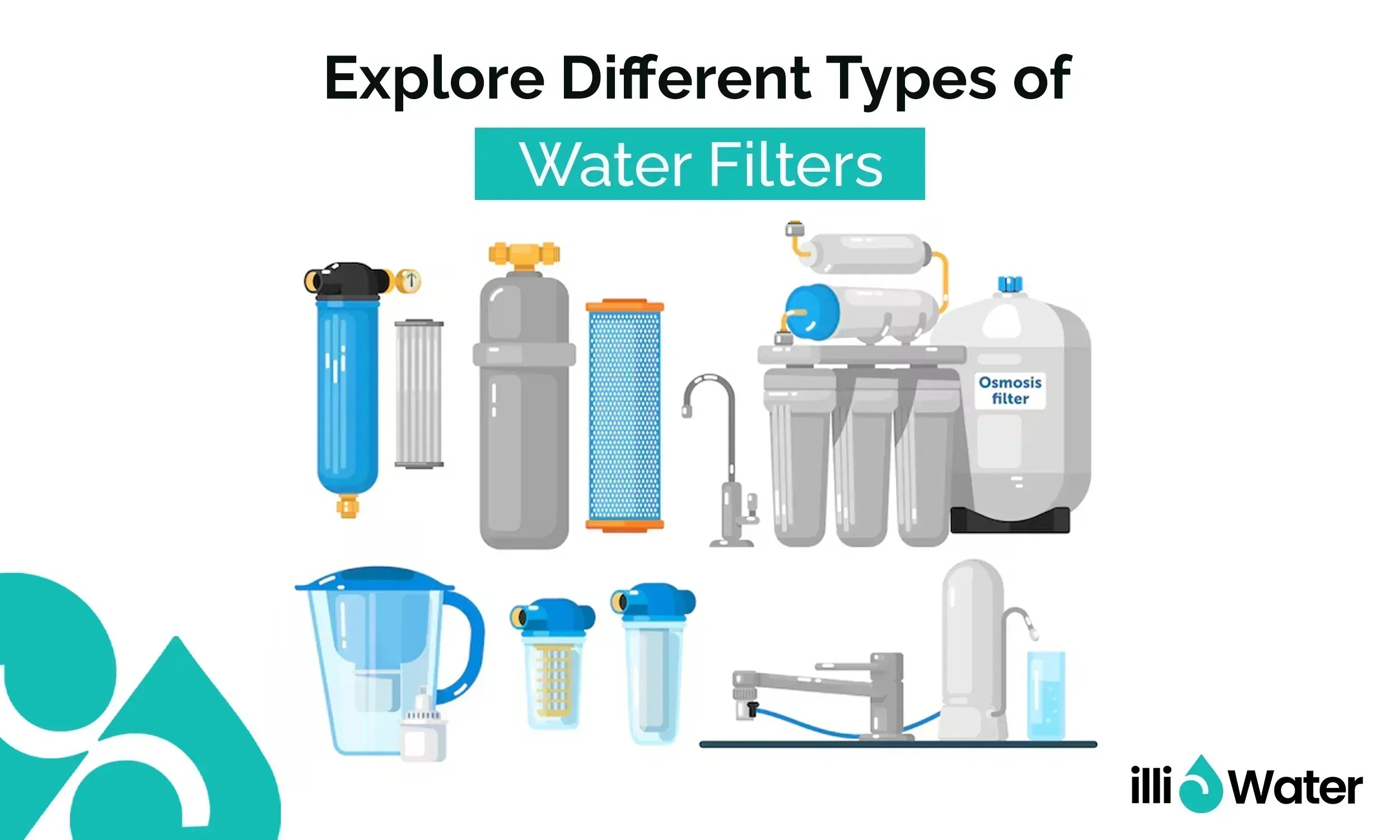
The market is packed with home water filters, making it difficult to choose the right one. Different water filtration systems target different impurities and serve distinct purposes. Some are great at removing bacteria and treating well water, while others excel at addressing hard water and enhancing the water’s taste.
Understanding the different residential water filter types is crucial for selecting the right water filter system that aligns with your household’s needs, water profile, and budget.
What is a Water Filter?
A water filter eliminates harmful contaminants from water, including sediments, dissolved solids, heavy metals, chlorine, hardness minerals, bacteria, and unpleasant tastes and odors. As a result, the water becomes safer and healthier for drinking, cooking, showering, cleaning, and other household activities.
How Does a Water Filter Work?
A water filter purifies water by passing it through one or more filtration stages. In a multi-filtration system, each stage targets specific impurities. As water moves through the system, its filters trap, absorb, and remove harmful chemicals and unwanted particles. Consequently, clean and safe water reaches your taps and showers.
The filter cartridge lies at the heart of a water filtration system. Different cartridges serve different purposes. Sediment filters trap dirt, rust, and sand, while carbon filters reduce chlorine and chemicals that give water a foul odor or taste.
We'll further discuss 7 different filter types and their uses below, building on this overview of how water filters work at the most basic level.
What Are the 7 Common Types of Water Filters?
Water filters are primarily categorized by their filtration process and technology. Different residential water filtration technologies address specific impurities and concerns, serving distinct water needs. Let’s give you a brief overview of the 7 most common and important types of water filters and their uses.

-
Reverse Osmosis Water Filters
-
Activated Carbon Filters
-
Ion Exchange Water Filters
-
Mechanical Water Filters
-
Ultraviolet Water Filters
-
Ceramic Filters
-
Mineral Addback Filters
Reverse Osmosis (RO)
Reverse osmosis (RO) is an advanced drinking water purification technology that eliminates up to 99% of wide-ranging contaminants. Typically, these include dissolved salts, nitrates, heavy metals, PFAS, total dissolved solids (TDS), and hardness minerals. A RO system filters water by pushing it through a semi-permeable membrane with a micron rating between 0.0001 and 0.001 microns.
A typical RO system comprises the following stages:
-
Sediment pre-filter: It removes sand, rust, silt, and debris.
-
Carbon pre-filter: It absorbs chemicals, chlorine, and impurities that affect the water’s taste and odor.
-
RO membrane: It filters heavy metals, dissolved salts, chemicals, and microscopic contaminants.
-
Post-filter: It further refines the water, giving it a crisp and pleasant taste and odor.
During the filtration process, the system discharges some water as wastewater. It flushes away the contaminant concentrate and also protects the RO membrane. While most RO systems have a wastewater-to-clean-water ratio of 3:1 or 4:1, advanced RO systems have a 1:1 ratio, which reduces wastewater.
Reverse osmosis systems deliver ultra-pure water with a remarkably better taste. They are primarily used for providing water for drinking and cooking, not whole-house use. These systems are perfect for health-conscious families and homes that have access to water with chemical contaminants, heavy metals, and high TDS (total dissolved solids) count.
Bonus Read: How Much Does a Reverse Osmosis System Cost in Canada?
Activated Carbon Filters
Activated carbon filters are one of the most affordable and commonly used water filters in Canadian households. Carbon filters are excellent at removing 85% to 99% of chlorine, unwanted taste, foul odor, pesticides, volatile organic compounds (VOCs), and other organic impurities. They purify water through adsorption. This process chemically binds contaminants to the carbon block’s porous surface as water moves through it.
There are two main kinds of carbon filters:
-
Granular activated carbon (GAC): Allows faster water flow
-
Carbon block filters: Provide finer filtration through longer contact time with water
Carbon filters trap impurities according to their pore size (micron rating). Generally, their micron rating ranges from 0.5 to 50 microns. Filters with large pores allow larger particles to pass through.
You can use carbon filters as standalone filters as well as pre-filters in RO systems to shield membranes from contaminants. The common installation types of carbon filters include:
-
Faucet-mounted units
-
Pitches
-
Whole-house filters
-
Under-sink systems
Activated carbon water filters are ideal to improve the quality and taste of municipally treated water for drinking and cooking.
Ion Exchange Water Filters
Ion exchange water filters are mainly used for softening water rather than complete purification. They use resin beads to exchange hardness minerals, such as magnesium and calcium, with potassium or sodium ions. Gradually, the resin saturates. A salt solution is used to regenerate it, which replenishes its softening capacity.
Ion exchanger filters are effective at removing 95% to 99.5% hardness ions from the water. Therefore, they also address hard water issues such as limescale buildup, reduced appliance efficiency, appliance damage, and the inability of soap to form lather. Soft water makes cleaning easier and better. Moreover, it feels gentler on your skin and hair and improves your skin texture and hair quality.
That said, ion exchange doesn’t remove heavy metals, microorganisms, or chemicals from water. For this reason, it is usually paired with other filters, such as RO systems and carbon filters, to comprehensively treat water.
Mechanical Water Filters
Mechanical water filters remove sand, debris, silt, and rust by physically blocking particles from passing through the filter media. These filters have a micron rating between 1 and 50 microns. The lower their micron rating, the finer the filtration.
Common types of mechanical filters include:
-
Pleated filters for high water flow
-
Mesh screens for removing coarse debris
-
Melt-blown or spun cartridges for depth filtration
Typically, mechanical filters are used as first-stage pre-filters in multi-stage water filtration systems to safeguard the later-stage filters. They reduce clogging, improve water clarity, and increase the lifespan of appliances and plumbing fixtures. Mechanical water filtration is particularly beneficial for homes with old plumbing and well water.
Ultraviolet (UV) Filters
Ultraviolet (UV) water treatment is a disinfection method to clean water as opposed to traditional filtration. It exposes water to ultraviolet light, which neutralizes viruses and bacteria present in the water by disrupting their DNA. UV filters offer protection only against parasites, viruses, and bacteria, including Giardia and E. coli. UV treatment works only on clear water. For this reason, pre-filtration is essential to eliminate light-blocking particles.
Key benefits of the treatment include chemical-free disinfection of water without changing its odor or taste. Moreover, it delivers microbiologically safe water instantly. To ensure the system works optimally, replace its UV lamp annually. These systems are best suited for households that use well water or biologically contaminated water.
Ceramic Filters
Ceramic filters use porous ceramic material to clean water by trapping fine sediment, protozoa, and bacteria. Their micro-porous ceramic block has a micron rating between 0.2 and 1.0 microns. Some ceramic filters feature a carbon core that removes unpleasant tastes, chlorine, and other organic chemicals. Since these filters don’t require any electricity to work, they are often used in rural homes, gravity-fed systems, and portable filtration units.
While ceramic water filters remove sediment and microbiological contaminants, they are ineffective at filtering chemicals, heavy metals, or dissolved solids. On that basis, they are best for households that need low-maintenance and simple water treatment.
Mineral Addback Filters
Mineral add-back filters remineralize water and improve its quality after RO filtration. While filtering impurities, the RO process also removes naturally occurring minerals such as calcium and magnesium from water. Remineralization filters replenish these minerals by passing pure water through additional mineral media. The reintroduction of minerals also slightly raises the water’s pH, giving it a more balanced taste. It’s crucial to note that mineral addback filters enhance water quality but don’t remove impurities. They are optional upgrades and are perfect for RO users who want pure and great-tasting water.
How to Choose a Water Filter for Your Canadian Home
To choose the right water filter for your home, first understand your home’s water profile and daily water consumption. Canadian water varies widely by area, source, and infrastructure age. For this reason, there is no one-size-fits-all water system. Whether you need better-tasting drinking water or clean water for other chores, the ideal choice depends on a clear understanding and practical evaluation of your needs.
Follow the steps outlined below to invest in the best water filtration system for your home.
-
Find out where your water comes from (municipal supply or private well)
-
Test your water for contaminants and hardness levels through a municipal report or a professional test
-
Identify the main problems (bad taste, odor, scale buildup, bacteria, metals, etc.)
-
Decide if you need filtered water at one tap or throughout the whole house
-
Choose the right filtration technology based on your water issues
-
Check for trusted certifications to confirm performance and safety
Once you've narrowed down the right system, factor in the long-term water filtration maintenance it will require, cartridge replacements, UV lamp swaps, resin regeneration, and membrane changes, all of which vary by filter type and directly affect the system's running cost and performance.
Which Type of Water Filter Is Best for You?
The best type of water filter depends entirely on your water quality, the contaminants you wish to remove, and which benefits of a water filtration system matter most to you.
-
Maximum contaminant removal: Of all types of residential water filters, reverse osmosis systems provide the most reliable water by filtering up to 99% of dissolved contaminants.
-
For taste & odor improvement: Activated carbon filters work best at delivering crisp, clear water with no unpleasant tastes or odors.
-
For hard water treatment: Ion exchange filters are excellent at removing scale-forming minerals, providing you with soft water.
-
For microbiological safety: UV or ceramic filters are ideal if you want safe water free of microbiological impurities.
-
For sediment protection and appliance longevity: Mechanical pre-filters shield your water system and appliances from sediment, silt, and rust to prevent abrasion and clogging. As a result, your appliances function more efficiently and last longer.
-
Multi-Stage/Hybrid Systems: Hybrid water filter systems use a powerful combination of RO, UV, mechanical, carbon, and mineral addback filters for comprehensive water filtration.
Benefits
-
Removes chemical contaminants, microbes, and other impurities
-
Softens hard water to prevent limescale formation
-
Provides great-tasting water without any unpleasant smells
-
Remineralizes water, offering more health benefits
Ideal For
-
Households with highly contaminated water
-
Health-conscious families who seek ultra-pure water
-
Homeowners who want mineral-rich water
Conclusion
Understanding the different types of water filters helps you choose an appropriate water filtration system that suits your household's needs and water profile. While distinct types of home water filters serve distinct purposes, it is nonetheless a wise idea to invest in a multi-stage or RO water filter system for ultimate peace of mind.
FAQs About Types of Water Filters
What filter type is best for removing heavy metals like lead?
Reverse osmosis filters are best at removing lead from water.
Are some filters better for high TDS water?
Yes, reverse osmosis filters are ideal for treating high TDS water.
Can I combine multiple filter types?
Yes, you can combine multiple types of filters for comprehensive water purification.
Do all water filters remove fluoride?
No, not all filters remove fluoride. RO systems are the best at fluoride removal.
Which water filters need professional installation?
Whole-house water filter systems and certain reverse osmosis systems require professional installation.
What is the most effective type of water filter?
A reverse osmosis filter integrated with a carbon block and UV filter provides the highest level of water purification.


