

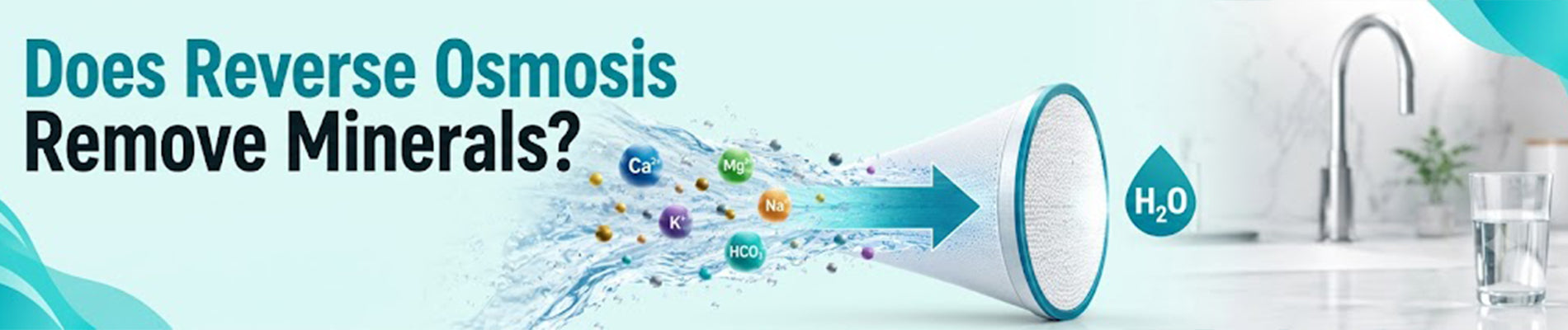
If you have bought, or are considering buying, a reverse osmosis system, you may have heard that it “strips” minerals from water. That naturally raises a bigger question: Does drinking low-mineral RO water create a health problem?
Yes, reverse osmosis removes most dissolved minerals from water. A properly functioning residential membrane commonly reduces total dissolved solids by approximately 90–99%, including much of the calcium, magnesium, and sodium. For most healthy Canadians, eating a balanced diet, this is not a nutritional concern because food supplies far more of these minerals than drinking water.
Key Takeaways
|
How Reverse Osmosis Removes Minerals From Water
A reverse osmosis system uses household water pressure to push water through a semi-permeable membrane. Water molecules pass through the membrane, while many larger dissolved ions and unwanted substances are rejected and carried away in the wastewater stream.
Because the membrane separates substances largely according to their weight and molecular size, it does not distinguish between an unwanted contaminant and a beneficial mineral. Similarly, it removes many unwanted substances like PFAs, microplastics, and other heavy metals.
Which Minerals Does Reverse Osmosis Remove?
Reverse osmosis reduces most of the dissolved minerals responsible for the hardness, salinity, and total dissolved solids in water.
The common minerals that are removed from the water include the following:
- Calcium: A major contributor to hard water, scale buildup, and appliance degradation.
- Potassium: Usually present at relatively low levels in drinking water.
- Magnesium: Contributes to the hardness and mineral taste in water.
- Sodium: Reduction varies with membrane performance.
- Iron and Magnesium: Pretreatment may be needed when concentrations are high.
- Fluoride: Certified RO devices can significantly reduce fluoride.
- Nitrates: Nitrates reduction performance is usually confirmed through product certification
- Lead and Arsenic: Reduction of heavy metals depends on the membrane and complete system design.
In addition to minerals, what does reverse osmosis remove, or what water problems does it solve? A properly designed system can reduce many dissolved salts, metals, and inorganic contaminants. Depending on its certification and filtration stages, it may also reduce heavy metal substances such as lead, arsenic, nitrates, fluoride, and certain polyfluoroalkyl substances, commonly known as PFAS.
However, “does reverse osmosis remove chemicals?” is too broad a question for a universal yes. No treatment or filtration systems remove every chemical equally. Some volatile organic compounds are handled more effectively by the activated-carbon stages commonly installed before or after an RO membrane.
When choosing a system for a specific water concern, check its certified performance data rather than relying on a general claim that it removes “everything.” If you are planning to buy an RO system, knowing what an RO system can do may help you make an informed decision.
How Much Mineral Content Stays in RO Water?
A residential RO membrane commonly reduces total dissolved solids, or TDS, by approximately 90–99%. The final mineral level, therefore, depends heavily on the incoming water.
TDS represents the combined concentration of dissolved minerals, salts, and other substances in water. It is measured in milligrams per liter (mg/L), which is approximately equivalent to parts per million for ordinary drinking water.
Feed-water chemistry, temperature, pressure, membrane condition, and whether the system includes a remineralization stage all affect the final TDS values.
Health Canada has established an objective of 500 mg/L or less for TDS. This objective concerns matters such as taste and scaling; it is not a nutritional minimum. Health Canada does not specify a minimum TDS that water must contain to be healthy.
A very low reading can help confirm that the membrane is reducing dissolved solids, but TDS alone cannot prove that water is safe. A TDS meter does not identify which substances are present or detect most microorganisms and organic contaminants.
Do the Removed Minerals Actually Matter for Your Health?
For most healthy people eating a varied diet, removing minerals from drinking water is not a nutritional concern. That does not mean calcium and magnesium are unimportant. It means that food is normally a much larger and more reliable source of these nutrients.
According to the National Institutes of Health, although reverse osmosis removes minerals such as calcium and magnesium, water is a minor source of these minerals in Canada compared with food.
It also states that people using RO systems have no harm in drinking RO water, as the mineral content coming from water does not fill the dietary needs of humans, so minerals from food and supplements play an important role in one’s well-being.
Minerals From Food Versus Water
If a person drinks two liters of water containing 30 mg/L of calcium, that water supplies 60 mg of calcium. An adult target of approximately 1,000 mg per day means the water contributes about 6%.
In softer water, the contribution could be much lower. Meanwhile, foods such as milk, yogurt, cheese, fortified plant beverages, tofu, canned fish, beans, and leafy greens can provide considerably more calcium.
The same principle generally applies to magnesium. Nuts, seeds, legumes, whole grains, and leafy green vegetables are more substantial dietary sources than most Canadian drinking water.
Water can contribute to overall mineral intake, particularly in regions with very hard water, but its contribution should not be confused with the body’s primary nutritional supply.
What the WHO Report Really Says
Online discussions sometimes claim that the World Health Organization declared demineralized water dangerous. That interpretation overstates the evidence.
In 2005, the WHO published Nutrients in Drinking-Water, which examined possible consequences of long-term consumption of water modified through processes such as desalination and demineralization.
The report considered several population-level questions, including the contribution of drinking water to mineral intake and whether cooking with very low-mineral water could affect minerals in food.
The potential importance of minerals in water depends on diet, nutritional status, local water composition, and the needs of the population being studied. Concerns may carry more weight where diets are already deficient or where desalinated water makes up a population’s entire water supply without appropriate stabilization.
For a typical Canadian eating a balanced diet, Health Canada’s practical conclusion is more directly applicable: food contributes far more calcium and magnesium than drinking water.
Does RO Water Pull Minerals Out of Your Body?
No credible medical reports or physiological mechanism supports the claim that ordinary RO drinking water travels through the body and strips minerals from bones, teeth, or tissues.
The concern usually starts with a real observation: water with very few dissolved minerals can dissolve substances it contacts under certain laboratory or plumbing conditions. That does not mean it behaves like a mineral-removing solvent inside the human body.
Once swallowed, RO water mixes immediately with saliva, food, stomach acid, and digestive fluids containing abundant electrolytes. The intestines regulate what is absorbed, while the kidneys continually balance water and electrolyte levels. Your mineral status is influenced primarily by diet, absorption, kidney function, and overall health, not by water attempting to “replace” its missing TDS from your tissues.
People with kidney disease, electrolyte disorders, severe nutritional deficiencies, or medically prescribed mineral restrictions should follow advice from their healthcare professional. For most healthy adults, however, drinking RO water does not cause the body to lose minerals.
Is RO Water Too Acidic to Drink?
RO water can have a slightly lower pH (ranging from 5.0 to 6.5) than the water entering the system. Removing minerals also removes much of the water’s alkalinity, leaving it with less ability to resist changes in pH. Exposure to carbon dioxide in the air may then cause its measured pH to fall slightly.
That does not make ordinary RO water dangerously acidic. Health Canada reports no evidence of a direct association between the pH of food or drinking water and adverse health effects. Its operational pH range for finished municipal water, 7.0 to 10.5, is principally concerned with treatment performance, corrosion, and the possible release of metals from plumbing.
RO water is normally dispensed through a dedicated point-of-use faucet, limiting contact with household plumbing. If you prefer a more mineral-like taste or a somewhat higher pH, a post-treatment remineralization stage can provide both.
How Do You Remineralize RO Water?
Adding minerals back to RO water is optional for most households. Remineralization is generally chosen to improve taste, raise alkalinity, or create a preferred water profile, not because untreated RO water is nutritionally unsafe.
Most remineralization methods add small quantities of calcium and magnesium.
Installing a Remineralization Cartridge
A remineralization cartridge is usually the simplest and most consistent option. It is installed after the RO membrane and storage tank, just before the dedicated faucet. As water passes through mineral media, small amounts of calcium, magnesium, or other alkaline minerals dissolve into it.
Cartridges must be compatible with the system and replaced according to the manufacturer’s schedule. Because their output can change with flow rate, contact time, and water chemistry, check the product specifications if you want a particular mineral or pH range.
Adding Mineral Drops
Food-grade mineral drops let you remineralize a glass, bottle, or pitcher without altering the plumbing. Formulas differ, so check which minerals the product contains and follow the dosing directions carefully.
Adding more than directed does not make water healthier. It can create an unpleasant taste or add unnecessary sodium and other electrolytes.
Using a Food-Grade Remineralization Product
Powdered electrolyte or remineralization blends are another manual option, particularly when water is being prepared for a specific use. Choose a product intended for drinking water and measure it accurately.
Ordinary Himalayan salt or sea salt is a poor substitute for a balanced remineralization product. It adds mostly sodium and chloride, while contributing only tiny amounts of calcium and magnesium. Adding enough salt to deliver meaningful quantities of those minerals could make the water excessively salty.
Adding an Alkaline Pitcher Filter
Some pitcher filters contain mineral media that may add calcium or magnesium and raise the pH of RO water. This route requires no plumbing changes, although the pitcher must be refilled and its cartridge replaced regularly.
Results vary widely by product. Look for clear performance information and avoid assuming that every filter labeled “alkaline” adds a nutritionally meaningful quantity of minerals.
Frequently Asked Questions
How much does a remineralization filter add to an RO system?
A replacement or add-on remineralization cartridge commonly costs approximately $40–$150 CAD, while parts and professional installation can bring the total closer to $150–$400 CAD, depending on compatibility and plumbing requirements. These are general market-rate estimates and should be validated before publication or purchase.
What TDS level should RO water have?
There is no universally required minimum TDS for health. Many residential systems produce water below 50 mg/L, but the correct result depends on the incoming water and membrane specifications. A sudden increase from the system’s usual reading may indicate that the membrane requires service.
Can I use RO water in an aquarium or on plants?
RO water can be useful for aquariums, but it normally needs species-appropriate remineralization. Fish and invertebrates may depend on specific general hardness, carbonate hardness, pH, and salinity levels.
RO water can also suit salt-sensitive plants. For long-term use, however, plants still need nutrients from soil or an appropriate fertilizer.
Does cooking with RO water reduce nutrients in food?
Minerals and water-soluble vitamins can move into cooking water regardless of whether tap or RO water is used. Cooking time, temperature, and whether the liquid is discarded usually matter more. Steaming food or using the cooking liquid in soups and sauces can help retain nutrients.
Does reverse osmosis remove fluoride from Canadian tap water?
Yes. Certified RO devices are among the treatment options capable of reducing fluoride. That may be desirable where fluoride levels are elevated, but it also removes fluoride intentionally added by some Canadian municipalities to support dental health. Families, particularly those with children, can ask their dental professional whether any change in oral-care practices is appropriate.
Deciding Whether RO Is Right for Your Home
So, does reverse osmosis remove minerals? Yes, it removes most dissolved minerals like calcium, magnesium, potassium, and fluoride, along with many harmful chemicals and substances. For the average healthy Canadian, that mineral reduction is not a health problem because a balanced diet remains the main source of calcium, magnesium, and other essential nutrients.
The better question is whether RO addresses your household’s water concerns. Consider your source-water quality, the contaminants you want to reduce, available under-sink space, maintenance requirements, and whether you prefer plain or remineralized water.
If you like the cleaner taste of RO water but want some calcium, magnesium, and alkalinity restored, choose a system with a post-filtration remineralization stage. Explore illi Water’s reverse osmosis systems to compare filtration capacity, installation requirements, and remineralization options for your home.


